When a crown is the supporting act for a missing tooth

Ask people what a crown does, and most say it covers a broken tooth. True, but it is only half the picture. In many mouths, the crown is a connector. It is the visible piece that makes a replacement tooth look and work like the real thing.
The finishing piece of an implant
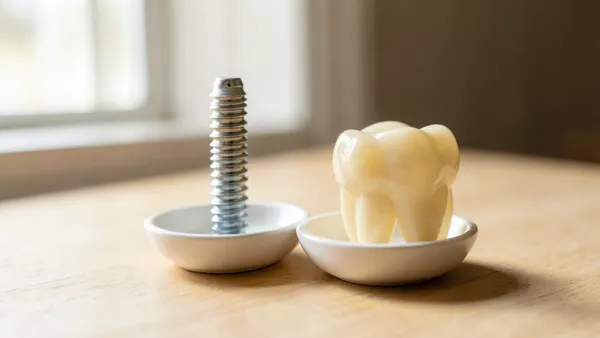
An implant is a small post placed in the jawbone where the root used to be. Alone, it is just a post. The crown snaps that post into a tooth you can chew with. It is shaped and tinted to blend with the teeth beside it, so the whole restoration reads as one smile.
Because the post has no nerve, the crown on top of it cannot feel pain the way a natural tooth would. The gums around it still need good brushing and flossing, though. Read more about the full process on our dental implants page.
The end caps of a bridge
A traditional bridge fills a gap by borrowing support from the teeth on each side. Those two neighbors are shaped and covered with crowns, and the replacement tooth sits between them like a plank across two posts.
This works well, and it is quick compared with some options. The tradeoff is that healthy teeth lose some enamel to serve as anchors. If those neighbors already have large fillings, that point matters less. If they are untouched, it deserves a longer conversation.
A second life for a root canal tooth
After a root canal, a tooth no longer has living tissue inside. It can still chew, but it tends to become more brittle over time. A crown around it works like a helmet. Back teeth take the hardest bites, so they are the usual candidates.
A fix for shape and shade
Sometimes the problem is how a tooth looks. A worn, uneven, or heavily stained tooth that does not respond to other options can be capped to match its neighbors. This is a last-step choice, since it involves reshaping, so ask about gentler alternatives first.
Choosing between a bridge and an implant
Both end with crowns, and each has a different cost to the teeth around the gap. A few questions help.
- Are the neighboring teeth already heavily restored?
- Is the jawbone healthy enough to hold a post?
- How long do you want the plan to take?
What each option asks of you
A bridge usually moves faster, and the main upkeep is cleaning underneath it with floss threaders or a water flosser. An implant takes more steps, because the post needs time to bond with the bone before the crown goes on, but nearby teeth are left alone. Neither is automatically better. Your health, your budget, and the condition of the teeth around the gap all count.
Keeping the crown part healthy
Whichever route you take, the crown is only as stable as what it sits on. For a bridge, that means healthy anchor teeth and gums. For an implant, it means clean tissue around the post. Brush twice a day, clean between the teeth daily, and keep your checkups so small gum changes get caught early.
Questions patients ask
Does a crown on an implant need a root canal?
No. An implant has no nerve, so the crown attaches to a metal post instead of a natural tooth. Care for it like any tooth, since the gums around it can still get inflamed.
Why does a bridge need crowns on healthy teeth?
The neighboring teeth act as anchors, so they are shaped and capped to carry the replacement tooth between them. That is a real tradeoff, and worth discussing before you choose.
If you are missing a tooth, call Boca Dental Group at (561) 338-6411 or book a consultation online to compare your options.
This article is general information, not a diagnosis. Call us to talk about your own teeth.